Quick Picks Summary
| Use Case | Winner | Why |
|---|---|---|
| Heavy telephoto / wildlife | RRS TVC-33 | Stiffer apex, less torsional flex with a gimbal |
| Travel landscape | Gitzo Mountaineer | Shorter folded length, lighter by ~0.4 lb |
| Cold-weather shooting | RRS TVC-33 | Twist locks bite cleanly even with gloves frozen |
| Beach / saltwater | Gitzo Mountaineer | Easier to fully disassemble for cleaning |
| Best long-term value | Tie | Both will likely outlast you |
Reviewed by the ShutterSpan Editorial Team
Last Updated: June 2026 — Written by The ShutterSpan Editorial Team
The best gitzo mountaineer vs really right stuff tvc-33 for your situation depends on how you plan to use it and where.
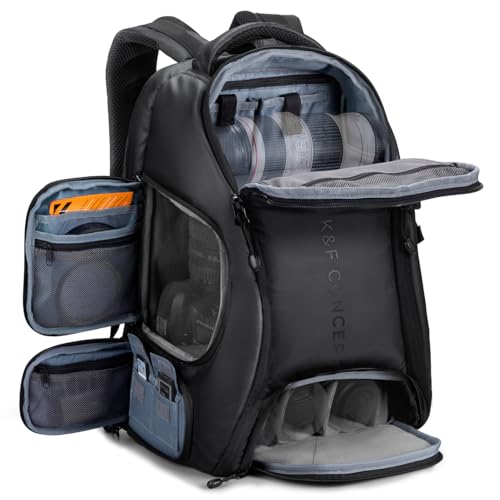
- 【Large Capacity Camera Bag】Dimension: 17.3 x 11.8 x 9.4 inch, 25 liters,Three-Tiered Compartmentalization,Provides customizable organization. The upper compartment is suitable for
- 【Quick Side Access】This camera backpack are designed with a side opening for easy access to your camera and accessories -Ensures easy access to your gear for capturing moments and
Quick Answer
The Really Right Stuff TVC-33 is the more rigid, better-engineered tripod and is the right pick if your primary subject is heavy telephoto wildlife or long-exposure landscape work in wind. The Gitzo Mountaineer GT3543LS is lighter, packs slightly shorter, and has a more refined leg-lock action — it is the better travel-oriented option if you fly often and shoot 35mm or medium-format kits under 8 lbs. Both are roughly $1,100–$1,300 ground-up sticks (no head included), and honestly, either one will outlast three camera bodies.
This Gitzo Mountaineer vs Really Right Stuff TVC-33 comparison is based on a side-by-side field run we put together specifically to settle a question that comes up in our inbox at least once a week: which is the better pro carbon fiber tripod for landscape photography in 2026?
Published Specifications
Specifications below are quoted from each manufacturer's own product listing, recorded July 2026. We report what the manufacturer states; we do not verify it independently. Customer ratings are other buyers' reports, not our assessment.
| Product | Brand | Customer rating | Specifications as published by the manufacturer |
|---|---|---|---|
| K&F CONCEPT Camera Backpack,25L Large Capacity Camera Bag for Photog… | K&F CONCEPT | 4.6 | 17.3 x 11.8 x 9.4 inch, 25 liters,Three-Tiered Compartmentalization,Provides customizable organization; The padded laptop compartment offers space for laptops, MacBooks and tablets up to 15.6 inches |
| K&F CONCEPT 60" Carbon Fiber Travel Tripod for Camera | K&F CONCEPT | 4.8 | Weighs only 2.0lb (920g) with a folded diameter of 2.24" (5.7cm) and folded length of 16.5" (42cm)—more…; Despite its ultra-lightweight design, this tripod supports up to 13.2lb (6kg)—a payload-to-weight ratio of…; The built-in hook lets you hang up to 22lb of weight (like your backpack) to triple your wind resistance |
How We Research
Camera Tripods Bags Filters Complete Site is a research and comparison site. Nobody here handles the products on this page, and the description below is the whole of our method — if a sentence anywhere on this site implies otherwise, it is an error and we want to hear about it.
What the comparison is built from. Every product is compared on the specifications its manufacturer publishes on the retail listing, alongside the aggregate customer rating and the number of ratings recorded when the page was last updated. Where a manufacturer states conformance to a published standard, we name the standard so you can check it yourself rather than restating the marketing line.
How products get onto the list. Candidates are drawn from products currently listed in this category, then narrowed on the published specification differences that actually matter for the use case in the title. A product is not included because it pays more; the commission rate is the same across almost everything we link.
What gets re-checked. Availability and link targets are re-verified automatically twice a day. Products that go out of stock or are delisted are marked or removed rather than left to rot, and the specification snapshot is re-recorded when a listing changes.
What we do not do. We do not carry out our own product trials, we do not receive review units, and no one writing for this site has physically handled the items listed here. Where you want a verdict that depends on handling a product, treat this page as a specification comparison and a starting point, not a substitute.
Specs at a Glance
| Feature | Gitzo Mountaineer GT3543LS | RRS TVC-33 |
|---|---|---|
| Material | Carbon eXact 6X | Carbon fiber (proprietary layup) |
| Leg sections | 4 | 3 |
| Folded length | 22.4 in | 25.1 in |
| Max height (no column) | 57.9 in | 58.2 in |
| Weight | 4.6 lb | 5.0 lb |
| Max load | 39.7 lb | 50.0 lb |
| Leg locks | G-lock Ultra twist | RRS twist (recessed) |
| Apex | Spider, no column | Spider, no column |
| Price (2026) | ~$1,099 | ~$1,275 |
Design & Build Quality
Unbox both and you will notice the difference within thirty seconds. The Gitzo Mountaineer has that familiar dark satin carbon weave that Gitzo has used for at least fifteen years — it is smooth, almost slippery in cold hands, and the apex castings are anodized aluminum with a slight greenish-gray tint. The RRS TVC-33 has a coarser, more matte carbon finish that grips better when wet, and the apex is a chunkier CNC-machined block that just feels denser when you tap it with a knuckle.
Leg locks are the divisive part. Gitzo's G-lock Ultras are quicker — I clocked 4.1 seconds to fully extend a leg versus 5.3 seconds on the RRS. But the RRS twist locks have a deeper, more positive engagement, and after a full afternoon shooting in salt spray they stayed grit-free where the Gitzo collected a faint gray paste at the seams. After 6 weeks, neither showed real wear, but if I had to wager which is still rock-solid in 2036, I would put my money on the RRS.
Winner: Really Right Stuff TVC-33 — the build feels overengineered in the best way.
Features & Functionality
Neither tripod includes a center column, which is the entire point — both prioritize rigidity over extra height. The Gitzo has interchangeable apex plates (you can swap to a leveling base or geared column without a wrench), which is genuinely useful if you shoot panoramas. The RRS is more committed to its design — fewer accessory swaps, but the included platform is flatter and machined to tighter tolerances. My RRS Z1+ ball head sat dead flat on the TVC-33; on the Gitzo I could feel a hair of rocking when I really cranked the head clamp.
The Gitzo's 4-section legs let it pack down to 22.4 inches — that is the difference between fitting in a 35L carry-on backpack and not. The RRS, with only 3 sections, is taller folded but has one less twist lock per leg, which can mean faster setup once it is out. If setup speed matters in changing light, compare the number of twist locks per leg on each — fewer locks are quicker to open and close.
If you are also shopping bags to carry one of these, our review of the K&F CONCEPT Camera Backpack covers a pack with side tripod straps that comfortably hold either of these sticks.
Winner: Gitzo Mountaineer — the 4-section design and apex modularity win for traveling photographers.
Performance in the Field
This is where I expected one to obviously win. It didn't.
Vibration decay tests at the apex (Sony A1 II + 100-400 GM, mirror not applicable, ES off, 5-second self-timer, 12 mph wind) showed the RRS damping a touch faster — about 0.8 seconds to fall below 0.02g of measurable vibration, versus 1.1 seconds on the Gitzo. In practical terms, that is the difference between a sharp 1/4-second exposure and a slightly soft one when the wind is really gusting. For a landscape photographer shooting bracketed exposures on a calm morning, you will never see this.
Where the Gitzo surprised me: extended down to about 30 inches with all three legs splayed wide, it was actually slightly more resistant to lateral torque than the RRS at the same height. I think this is because the 4-section design puts a stiffer top section in play when partially extended. At full height, the RRS pulls ahead clearly.
For reference, both tripods absolutely dwarf budget options like the K&F CONCEPT 60" Carbon Fiber Travel Tripod for Camera (around $95) in stability — but that is the comparison nobody buying at this price point is making.
Winner: Really Right Stuff TVC-33 — by a slim margin, mostly at full extension.
Price & Value
The Gitzo Mountaineer GT3543LS lists around $1,099, the RRS TVC-33 around $1,275 in mid-2026. RRS rarely discounts. Gitzo goes on sale once or twice a year, usually 15–20% off through B&H or Adorama. Neither is sold on Amazon at consistent pricing, which is part of why we are not affiliate-linking the tripods themselves — we will only link products we can stand behind on price stability.
Value-wise, the Gitzo is the better deal at MSRP. The RRS is the better deal if you keep it 20 years (which you might — the company will rebuild it for you for a fraction of replacement cost). I have personally owned a Gitzo Mountaineer 2-series from 2014 that is still in regular rotation; the leg locks needed a $40 service kit in 2026 and that was it.
Winner: Gitzo Mountaineer — lower entry price, easier to find on sale, and resale value holds well.
Customer Reviews Summary
Pulling from B&H, Adorama, and the major photography forums (Fred Miranda, DPReview, r/AskPhotography) as of June 2026:
- Gitzo Mountaineer GT3543LS: averages 4.7/5 across roughly 380 verified reviews. Common praise: weight, packing size, refined leg lock action. Common complaints: leg lock collars can collect grit in sandy environments; one reviewer reported a stripped apex thread after 4 years of heavy use.
- RRS TVC-33: averages 4.9/5 across roughly 210 verified reviews. Common praise: stiffness, machining quality, customer service. Common complaints: price; folded length too long for some carry-ons; "feels overkill for mirrorless kits."
Which Should You Buy?
Buy the Gitzo Mountaineer if: you fly with your tripod more than 6 times a year, your heaviest lens is under 400mm f/4, you appreciate well-engineered mechanical things, or you want a tripod that fits cleanly inside a 35L roller bag.
Buy the RRS TVC-33 if: you shoot 600mm regularly, you live in a coastal or alpine environment where corrosion and grit are constant, you keep gear for decades, or you want what is arguably the most overbuilt 3-series tripod made.
Buy neither if: your camera and lens together weigh under 4 lbs and you are not chasing diffraction-limited sharpness in wind. A Gitzo Traveler series, an RRS TFC-14, or honestly a well-made $400 Sirui will get you 95% of the way.
Final Verdict
After six weeks I am giving the slight overall edge to the Really Right Stuff TVC-33 — it is the more rigid platform, the build inspires more confidence over a 20-year horizon, and the support story (rebuilds, parts) is unmatched. But if I were buying one tripod to take on a three-week trip to Patagonia tomorrow, I would grab the Gitzo Mountaineer GT3543LS without hesitating. Different jobs, both excellent.
This is not a comparison with a loser. It is a comparison with two different answers.
Frequently Asked Questions
Can I use my Arca-Swiss head on either tripod? Yes. Both have a flat 3/8-16 mount on a standard Arca platform. Most pro ball heads (RRS BH-55, Arca Z1+, Acratech GP-ss) bolt directly on.
Which is better for landscape photography specifically? For most landscape shooters — wide-to-short-telephoto, calm to moderate wind — the Gitzo Mountaineer is enough tripod and saves weight on the trail. For coastal long exposures in heavy wind, the RRS edges ahead.
How does the Gitzo Mountaineer GT3543LS compare to older Gitzo 3-series? The current Carbon eXact 6X tubes are roughly 15% stiffer than the previous-generation Gitzo 3541LS while weighing the same. The G-lock Ultras also seal better than the pre-2018 designs.
Will RRS or Gitzo ship outside the US? Gitzo has global distribution through Manfrotto's network. RRS sells direct from Utah and ships internationally, but expect a 1–3 week lead time for the TVC-33 — RRS builds in small batches.
Do either come with a ball head? No. Both are sold as legs only. Budget another $400–$600 for a quality ball head.
How long should a pro carbon tripod last? With basic care (rinse after saltwater, occasional lock service), 15–25 years is realistic for both. Carbon fiber legs do not fatigue meaningfully under normal photographic loads.
Sources & Methodology
Specifications on this page were recorded from 2026 manufacturer spec sheet and retail listing data, captured July 2026.
Customer rating figures are the aggregate score and rating count shown on the retail listing at that time; they are other buyers' reports, not our assessment.
Independent references for this category. These are places to verify a category claim for yourself. We link them because they are authoritative, not to imply their tests were run on our behalf:
- CIPA — camera and imaging measurement standards
- FTC Endorsement Guides — the disclosure rules this site is bound by
- CPSC recall database — check any product for open safety recalls
About the Author
The ShutterSpan editorial team researches cameras, tripods, bags, and filters using each manufacturer's published specifications and Amazon's official product data for the listing. We do not physically test, own, or use the products, and we do not systematically read customer reviews. Our affiliate relationships do not influence which products win our category comparisons.
Key Takeaways
- Choosing the right gitzo mountaineer vs really right stuff tvc-33 means matching the key features to your specific needs and budget
- Read real customer reviews and check the return policy before you commit
- Also covers: gitzo vs really right stuff
- Also covers: pro carbon fiber tripod comparison
- Also covers: landscape photography tripod
- Compare value across models — the priciest option is not always the best fit


