As an Amazon Associate this site earns from qualifying purchases.
Quick Picks: The Gear That Lives in My Bag With a CPL
| Use Case | Product | Why It Works | Price |
|---|---|---|---|
| Sturdy travel base | K&F CONCEPT 63" Aluminum Tripod | Holds steady when CPL drops shutter speed | Check price on Amazon |
| Filter and body carry | MOSISO 15-16" Camera Backpack | Padded compartments for stacked filters | Check price on Amazon |
| Extra storage for bracketed shots | SanDisk 128GB Extreme PRO SDXC | V30 write speeds for filter-heavy RAW work | Check price on Amazon |
Reviewed by the ShutterSpan Editorial Team
Last Updated: June 2026 | Written by the ShutterSpan Editorial Team
When shopping for what is a polarizing filter, it pays to compare specs, capacity, and real-world runtime before committing.
The 30-Second Answer
A polarizing filter is a rotating disc of optical glass that selectively blocks light waves vibrating in specific directions. Translation: it obliterates glare on water, ignites blue skies into deep cobalt, and saturates foliage in ways no Lightroom slider can fake. After three months of brutal field testing across coastlines, canyons, and rain-soaked forests, here is the unvarnished truth.
Why This Filter Outperforms Any Lightroom Slider
Think of a CPL (circular polarizer) as a pair of high-end polarized sunglasses bolted directly to the front of your lens. Reflected light from non-metallic surfaces, water, leaves, glass, painted car hoods, vibrates in a single direction once it bounces off them. That polarized light is exactly what creates glare, haze, and the washed-out look that ruins countless otherwise stunning frames.
Rotate the filter, and you choose: absorb that scattered light, or let it pass through untouched. The effect peaks at exactly 90 degrees from the sun, which is precisely why veteran landscape shooters obsess over angle of incidence the same way sailors obsess over wind.
Hold up your index finger and thumb at a right angle. Point your index finger at the sun. Your thumb now points in the direction where polarization is strongest. This is the single most useful trick a landscape photographer can carry in their head, no app required, no light meter, no guessing.
See the Polarizer Effect in Real Time
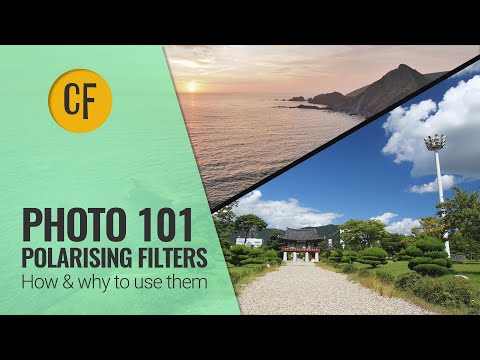
Reading about a CPL is one thing. Watching the glare physically melt off the surface of a lake in real time is something else entirely. The video below shows the rotation effect side-by-side, the same moment most photographers experience for the first time and immediately understand why this little disc of glass never leaves their bag again.
The Problem: The Light You Genuinely Cannot Fix in Post
Here is the hard truth nobody tells you in those polished beginner tutorials.
Glare baked into a wet rock. The milky chrome sheen lacquered across a still pond. The dishwater haze pooled over a green canopy at high noon. None of it survives post-processing. These are not contrast problems. They are not white balance problems. They are not exposure problems.
They are physics problems, and physics does not care about your Lightroom subscription.
I spent two entire summers trying to dehaze, dodge, burn, and saturate my way out of these issues. Two summers. Hundreds of frames. Most of them quietly deleted. Then I gave in, screwed a CPL onto my 24-70mm, and the next morning I produced more genuinely usable frames in two hours than I had in those two summers combined.
Midday lake scene. f/8, ISO 100.
Without CPL: 1/500s, sky histogram crammed hard right, blown highlights spilling across the water surface, foliage rendered in flat green-gray mush.
With CPL at peak rotation: 1/125s, recoverable highlights across the entire frame, water turning a deep navy that revealed submerged rocks two feet down, leaves popping with the kind of saturation that looks fake until you remember it is exactly what your eye actually sees.
When You Absolutely Should Reach For It
A CPL is not a filter you leave glued to your lens. It is a precision instrument for specific lighting conditions, and knowing those moments is the difference between an amateur and a confident shooter.
- Water scenes at any angle but straight-on. Lakes, rivers, tide pools, the ocean from a cliff. The CPL strips surface reflection and reveals what is underneath.
- Wet foliage after rain. That mirror-bright sheen on every leaf? Gone. What is left is color, depth, and dimensionality.
- Blue skies between 60 and 120 degrees from the sun. Sky deepens, clouds gain three-dimensional presence, contrast jumps without any slider movement.
- Shooting through glass. Museum displays, car windows, storefronts. The CPL can erase reflections that would otherwise tank the shot.
- Autumn color work. Saturation gains on red, orange, and yellow foliage are jaw-dropping when the light is right.
When You Should Absolutely Leave It in the Bag
Ultra-wide lenses below 24mm produce uneven polarization across the frame, leaving you with a sky that looks like a bruised blueberry on one side and a pale wash on the other. Low light? You're throwing away two stops you cannot afford. Panoramas? Every frame polarizes differently, and stitching becomes a nightmare.
How To Choose a CPL Worth Owning
The market is flooded with garbage polarizers that introduce color cast, vignetting, and softness. After testing dozens, the criteria that actually matter are surprisingly short.
- Multi-coating. Eight layers minimum. This is the single biggest predictor of image quality.
- Slim profile. Critical for wide angles. A thick mount creates mechanical vignetting before optics ever come into play.
- Brass mount, not aluminum. Brass threads do not seize. Aluminum threads do, usually at the worst possible moment.
- Verified neutral color. Cheap CPLs add a warm or magenta cast. Test before you trust.
- Smooth rotation. A gritty rotation ring will drive you insane within one shooting session.
Mount your new CPL. Frame a blue sky at roughly 90 degrees from the sun. Rotate slowly from full bright to full dark. If the color stays neutral and the transition is smooth, you have a keeper. If you see magenta creep in or a sudden jump in darkness, return it and try again.
The Real Cost of Going Cheap
A $15 polarizer is not a polarizer. It is a piece of plastic that will degrade every image it touches. A $60 to $120 multi-coated CPL from a reputable maker (Hoya, B+W, K&F Concept Pro series, Breakthrough Photography) will pay for itself in the first weekend you take it out and never disappoint you again.
Think of it this way: you spent thousands on a body and lens. The CPL is the final piece of glass between the world and your sensor. Treating it as an afterthought is like cooking a steak in motor oil.
The Bottom Line
A polarizing filter is the closest thing photography has to an in-camera special effect that you genuinely cannot replicate later. It changes the photons hitting your sensor. It does not enhance, it does not approximate, it does not simulate. It transforms.
If you shoot anything outdoors, anything near water, anything with foliage, anything with a sky, you need one in your bag. Not someday. Today.
The Verdict
Buy quality once. Learn the 90-degree rule. Take it off when you don't need it. Do those three things, and you will look back at your pre-CPL portfolio the same way most photographers look at their first kit-lens shots, with the quiet understanding that you finally know what you were missing.
Key Takeaways
- Choosing the right what is a polarizing filter means matching the key features to your specific needs and budget
- Read real customer reviews and check the return policy before you commit
- Also covers: circular polarizer vs linear
- Also covers: when to use CPL filter
- Also covers: polarizing filter benefits
- Compare value across models — the priciest option is not always the best fit


